
ARTIST BIOGRAPHY
Veda Kagabo is a Rwandan-born abstract painter based in New Jersey, and founder of Veda Studio Art. Born in Nyamasheke near Lake Kivu, he has lived across Africa, Asia, Europe, and North America. Experiences of displacement, loss, and cultural transition inform his exploration of memory, identity, and belonging.
Working primarily in acrylic on canvas, Kagabo builds layered surfaces through color, texture, gesture, and erasure. Pathways, horizons, and architectural forms emerge from his paintings, suggesting places remembered, imagined, or left behind. His work considers how people carry the traces of home through change, and how absence and longing shape their relationship to the present.
Kagabo’s exhibition history includes a solo presentation at Verona Public Library and group exhibitions with Studio Montclair and the Newark Arts Festival. His paintings are held in private collections.
Through his work, Kagabo seeks to create space for people to explore difficult feelings, give form to experiences that resist words, and connect with others through art.
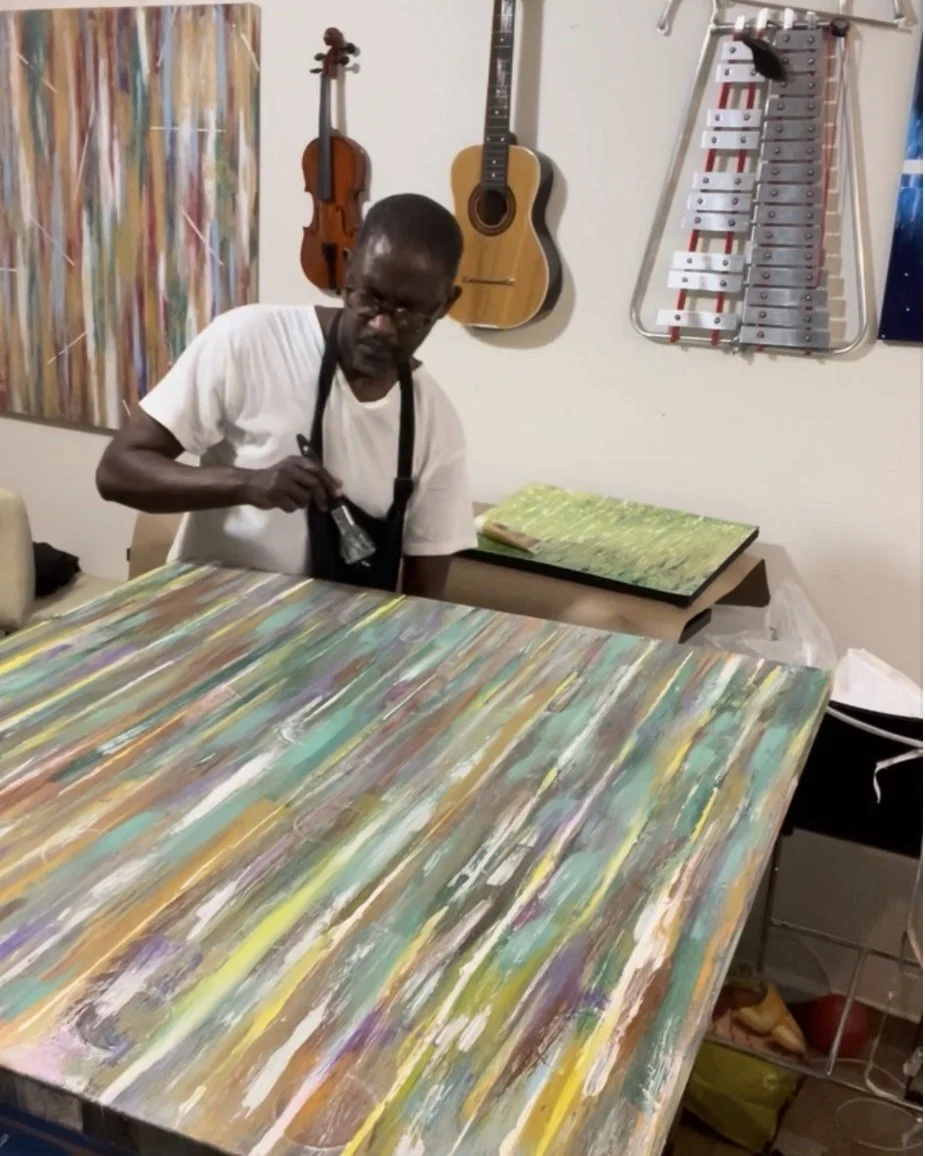
ARTIST STATEMENT
My paintings explore how experience becomes memory, and how memory shapes our sense of who we are and how we move through the world.
Drawing from my journey through displacement, survival, and renewal, I work primarily with acrylic on canvas, building layered surfaces through brushwork, palette knife, and direct handwork. Marks are covered, interrupted, and revealed, leaving traces of what came before.
Within these textured fields, pathways, horizons, and fragments of imagined places emerge. They hold the tension between loss and possibility, the desire for direction and the uncertainty of what lies ahead. My encounters with the natural world—water, mountains, skies, and the life beneath the surface—also nourish the work, offering moments of wonder and communion with God.
Although my paintings begin with personal experience, I leave their meanings open to others. I hope they offer space to pause, give attention to feelings that resist words, and recognize something of oneself. For someone carrying grief, dislocation, or an unspoken burden, that encounter may offer a moment of connection or the feeling of being less alone.
Through abstraction, I explore what we carry, what sustains us, and how we continue to find meaning and reach toward one another.